

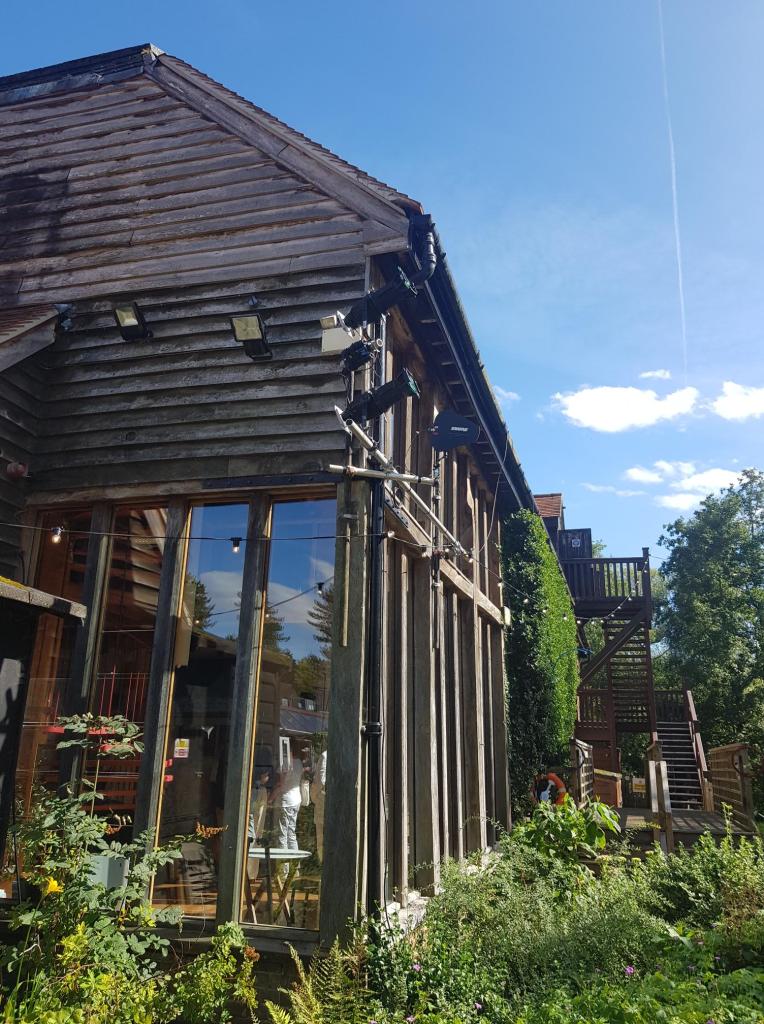
It is the perfect summer day when I step out of the taxi at the Watermill Theatre in Berkshire and after almost three hours on the train to get here. This venue, surrounded by clear streams and beautiful willows, is a ten-minute drive away from Newbury station with no public transport alternatives available: A journey you would not make there and back again in a single day for a random piece of theatre. But at today’s midday hour it is like stepping straight into the Shire, its lush meadows and rustic cottages. The historic building complex, including a watermill, fits well into J.R.R. Tolkien‘s descriptions, firstly published in The Hobbit in 1937: The perfect surroundings for a semi-immersive staging of its epic sequel The Lord Of The Rings, brought on stage as a musical tale (rather than a musical), embracing any nook and cranny of its surrounding and making space in England for the archaic continent of Middle Earth.
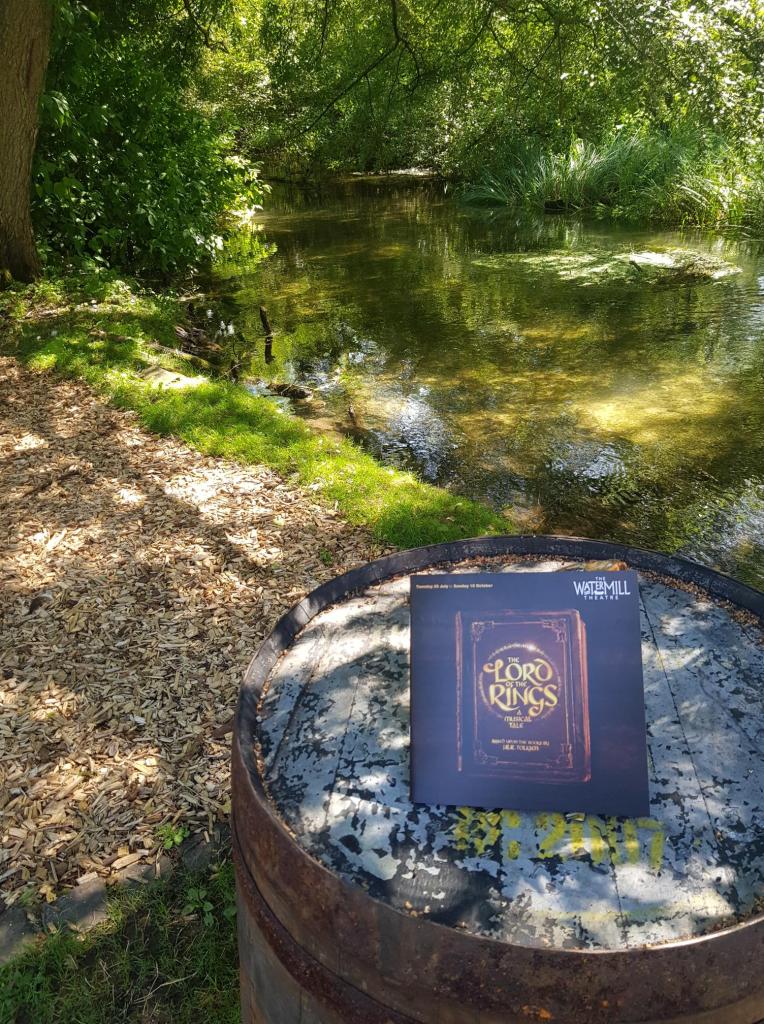
Starting with Bilbo Bagging’s 111th birthday preparations and celebrations under big trees the author would have loved, the afternoon performance stuns with a impressive vast presence on stage and invites guests to play whack-a-rat, learn to juggle and to throw rings. I wonder already if the evening performance grants enchanting fireworks.
Uncle Bilbo himself (played by John O’Mahony) welcomes every table personally, shaking hands and returning well wishes. After his infamous speech and vanishing though, all guests – cast and visitor alike – are moved from the party grounds into the the actual theatre (this way we even see the working watermill wheel in action behind glass). Having purchased one of just two remaining seats only in the previous week my seat is at the stalls’ back in the corner – a lady who has come here since the 1980s shares dauntingly that this very seat is usually reserved for actors. And I should better prepare myself to be involved. That does not happen but my seat is indeed a blessing: Actors and musicians alike pass through the door to my right, so I can admire costumes and instruments through the upcoming three hours of performance.
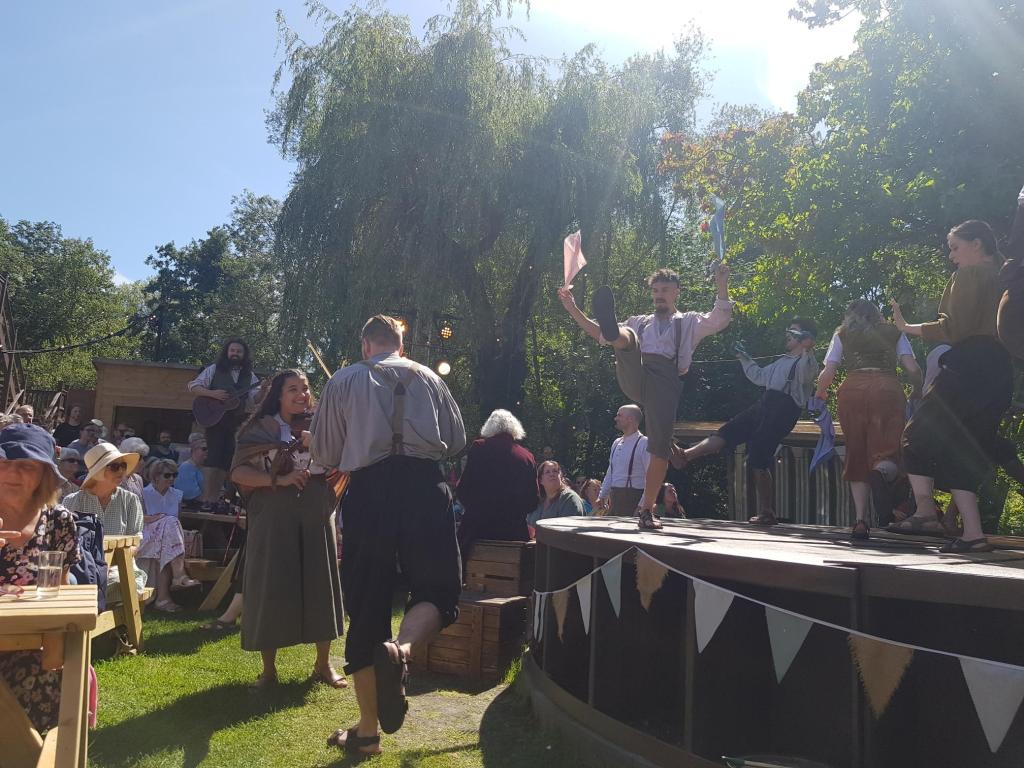
The shortening of the original plot is inevitable when you take a six-part novel published in three instalments which has been read by generations since its first publishing in the 1950s – the attempt to stage it is a brave act in any case, given decades of high and low budget interpretations in all possible mediums across the globe. And therefore, the Watermill Theatre’s production wisely focusses on the core narrative, of the adventures and destinies of the Fellowship of the Ring founded in the first of three books, setting out to destroy a ring of magical powers through unthinkable dangers – initially led by the wizard Gandalf (Peter Marinker), later all shattered by unimaginable conflicts. For purists this means, amongst other sadly left out story branches, that Theoden and Denethor merge to a single character, the painful absence of Eowyn and Faramir (the all too often discarded Tom Bombadil at least gets a mentioning) and, in a play scarce of female characters, a bigger part for the elven lady Arwen (Aoife O’Dea). The interpretation of the semi-divine elves is far from mine, neither in costume nor song, but the elvish vision brought to stage is strong enough to stand up for itself, and especially independently from Howard Shore’s popular film soundtracks. Generally, rarely is a sight obviously lent from an existing interpretation, not even from Professor Tolkien himself whose own drawing of the dooming gates of Moria, hewn into the mountains, have been added in all printed issues – here it is another. Cladding orcs in cargo trousers and leather jackets over grey hoodies with painted gas masks could have gone terribly wrong and appear trashy but here it is not only brave but strangely believable: The challenge of creating something new for this ever so fitting venue has been fully embraced. There is a solely acoustic appearance of tree giants, elaborate puppetry of ghost horses and a giant spider to haunt one for days after, carefully placed use of projection art and shadow play – and no matter how various and persuasive the effects are being utilised, not once again do they show off: There is something very humble about this not at all minimalistic production. And indeed, that seems to be the intention: “It takes a small village to put a show like this together”, Projection Designer George Reeve is quoted in the printed program.
Tolkien included poems and songs in many chapters across all his works so it is only naturally to embrace these: The Lord Of The Rings is performed by a strong cast of twenty multi-instrumentalists, never separating sounds and narrative through the anonymity of an orchestra pit. Therefore it is almost always busy on the relatively small stage and the paths leading from it with actors changing roles and instruments by the minute. This could appear chaotic but it pays out: The fascinating soundtrack teleports the audience to and through Middle Earth, through fields and forests, mountain peaks, caves, wastelands, hidden paths and battle fields – the arrangements of flute, French horn and kettledrums during fighting scenes is especially remarkable. The young hobbit Pippin (Amelia Gabriel) is hardly seen without an accordion or the bouzouki, tuning cheerfully into folk hobbit lore. Thankfully these stand for themselves once again and are not the mock Celtic tunes so often heard in sword-and-sorcery contexts – my favourite is the long-overdue song about the cat who climbed over the moon, performed in the Prancing Pony pub on an early leg of the journey, and for once it is me who is almost disappointed that there is no audience clap-along. The song of the dwarf Gimli (Polarin Akinmade) in the darkness of the mountains stands out as well; almost all characters get a tune, even the torn antagonist Gollum (Matthew Bugg). How much care and thought has been put into the cast, is best shown by a very gentle Aragorn (Aaron Sidwell) while Frodo’s voice (of Louis Maskell) immediately makes me think of Ian Holm’s interpretation on the 1981 BBC audio plays. Peter Dukes’ bariton is a nod to Sean Bean’s Boromir in Peter Jackson’s films and fits also as the voice of the ent Treebeard. In the mild early evening, cast and auditorium return after many adventures back outdoors to the Shire – since we left, a lot has happened here but together we return it to the peaceful garden it has always cared to be, a place of home, lush greenery and of good food and drinks and heartiness so urgently needed in the world.
Eventually the time comes for departure, first for some key figures, then for the audience. Tears. Standing Ovations. Somethings tells me that the Professor, who was not keen of many interpretations of his oevre, would have approved.

***** out of 5 stars
Books and Lyrics based on The Lord Of The Ring by J.R.R. Tolkien by Shaun McKenna and Matthew Warchus, music by A.R. Rahman, Värttinä and Christopher Nightingale
The Lord Of The Ring played at the Watermill Theatre until October 2023 and is currently preparing a transfer to America with the US premiere being scheduled for 19 July at the Chicago Shakespeare Theatre.
My seat H12 in the stalls cost £57.50

 Sadie takes the Stage